
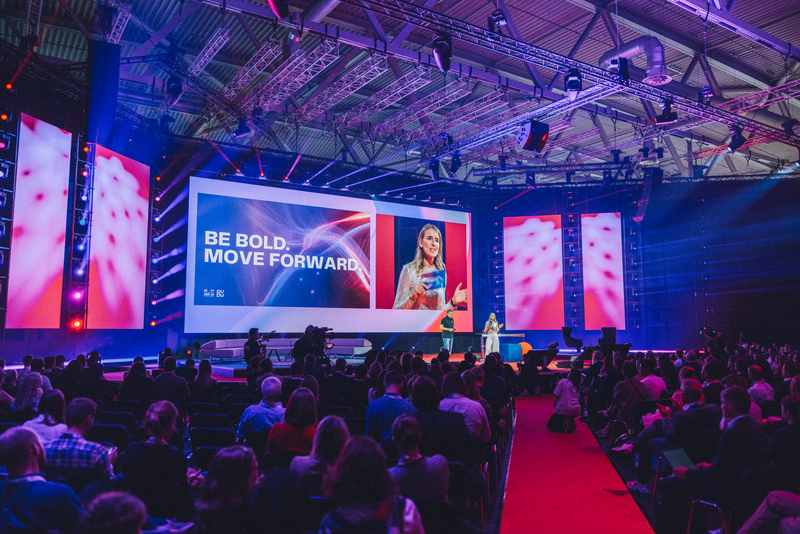
Cologne — DMEXCO 2025 arrived with an unusually confident instruction to the digital industry: Be Bold. Move Forward.
After two days in Cologne, the more interesting conclusion was not that the industry had become bolder. It was that the meaning of “moving forward” had changed.

Artificial intelligence was everywhere at DMEXCO — in search, commerce, advertising, customer experience, creative production and agency discussions. But the event was no longer primarily about demonstrating what AI can do. Increasingly, the conversation was about what companies can actually build with it, how those systems fit into existing organizations, and whether the promised gains can be measured.
That distinction may prove to be the most important legacy of DMEXCO 2025.
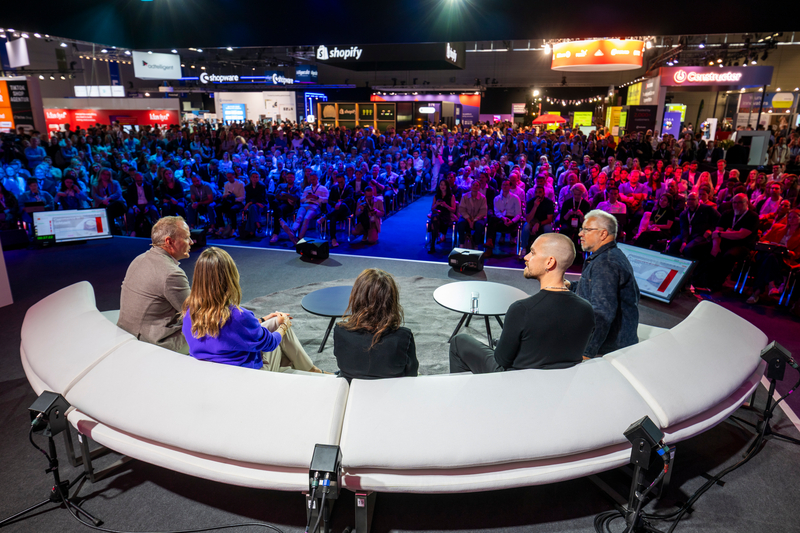
The scale of the event was considerable. More than 40,000 participants attended, alongside more than 700 exhibitors and partners and around 1,000 speakers across 17 stages. The organizer also reported roughly 20% more visitors from advertising companies and more than 2,000 brands represented among attendees.
But the numbers tell only part of the story. The more revealing signal was the structure of the conversation.
AI is no longer the story. It is becoming the infrastructure.
A year ago, many conversations around generative AI were still focused on experimentation: what models could create, how quickly they could produce content and which new applications might emerge.
At DMEXCO 2025, the emphasis had shifted.
AI appeared less as a standalone innovation category and more as an operating layer across marketing. Search, commerce, personalization, customer experience and creative workflows were increasingly being discussed as connected systems rather than separate disciplines. The event’s official post-show assessment similarly identified generative AI as moving from a buzzword into an integral part of everyday workflows.
That shift matters because it changes the central business question.
The question is no longer simply whether AI can produce an image, write copy or assist a marketer. It is whether an organization can redesign its processes around intelligent systems without losing control of data, brand identity, accountability and customer trust.
DMEXCO’s 2026 positioning makes that transition explicit. Its new motto, Scaling Intelligence, describes a move away from AI experimentation toward measurable operational and economic value.
In other words, 2025 was about proving that AI works. The next phase is about proving that it works at scale.
The human premium is rising alongside automation
There was an apparent contradiction at the heart of DMEXCO 2025.
The more aggressively AI entered the marketing stack, the more valuable concepts such as authenticity, cultural relevance and human judgment became.
On the CMO side of the conference, Lufthansa’s Olivier Krüger argued that authenticity is becoming a form of brand capital in an environment of hypertransparency. Spotify’s Yves Brunschwiler similarly framed genuine audience relationships around thinking like a fan rather than simply reaching one.
This is not an anti-technology argument.
It is a recognition that automation can make content abundant without making it meaningful.
If every brand can generate thousands of images, videos, headlines and variations, the scarce resource is no longer content production itself. It is judgment: knowing what deserves to exist, what fits a brand, what resonates culturally and what should not be automated.
That may become one of the defining competitive advantages of the next stage of AI marketing.
Search is being rebuilt — and so is discovery
Search was another major fault line.
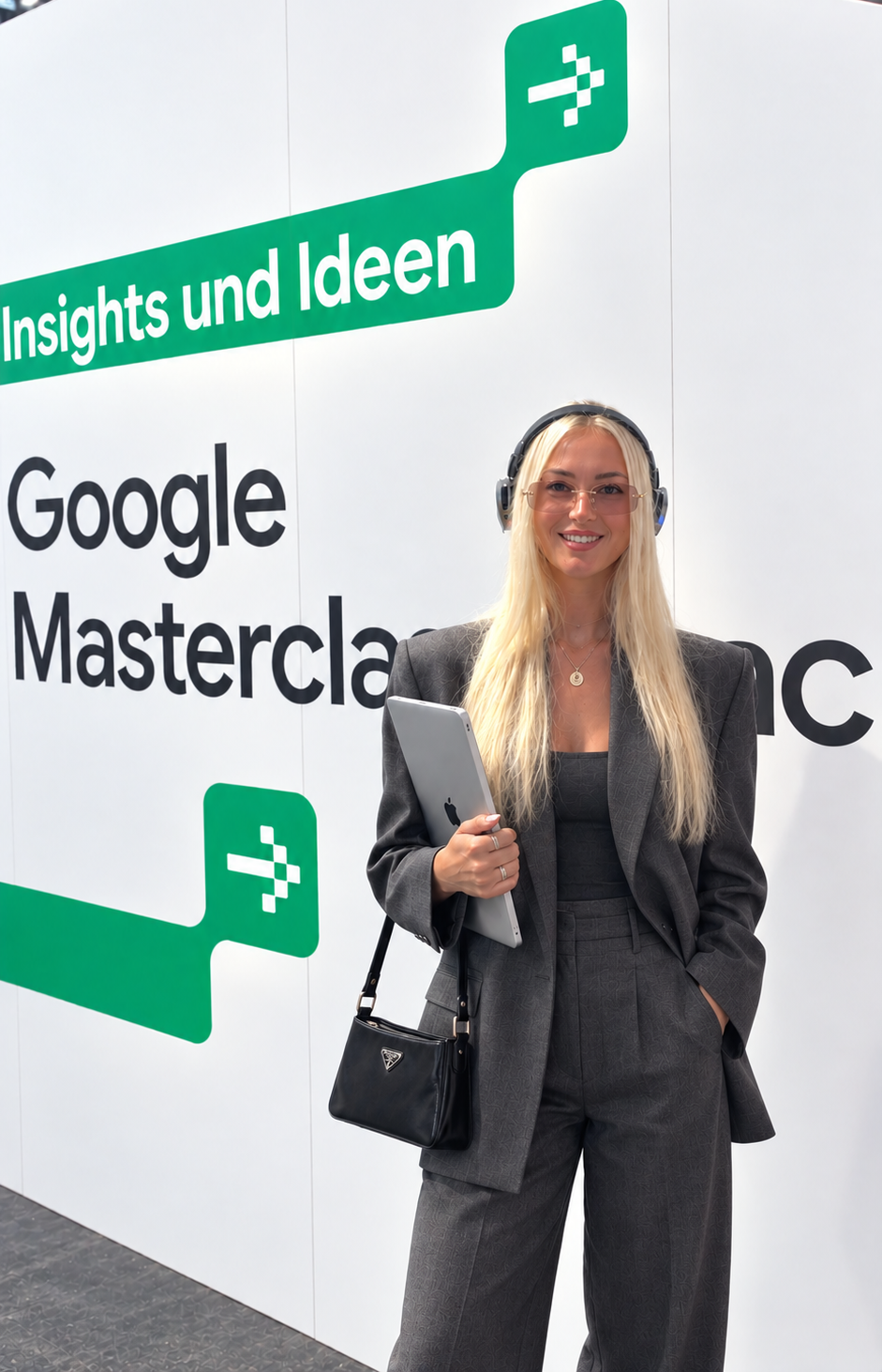
Google’s opening keynote at DMEXCO focused on the future of Google Search, while the wider conference examined the growing role of AI-powered discovery, creators, social platforms and alternative paths to information.
For marketers, the traditional model of optimizing content for a single search interface is giving way to a much more fragmented discovery environment. Consumers can encounter a brand through traditional search, an AI assistant, TikTok, Reddit, YouTube, creator content, marketplaces or increasingly through conversational interfaces.
This means that visibility is becoming less about ranking in one place and more about being understood across an ecosystem of interfaces.
Commerce is moving beyond the storefront
Commerce was another central theme at DMEXCO 2025, and its significance went well beyond e-commerce technology.
The Commerce Summit brought together discussions around social shopping, omnichannel strategies, AI-driven personalization and composable commerce.
At the same time, Digiday’s reporting from the event highlighted the convergence between commerce, advertising and data. Criteo CEO Michael Komasinski discussed the rapid expansion of e-commerce and argued for an agency-style, full-funnel approach, while emphasizing interoperability, identity standards, measurement and AI’s impact on product search.
That points toward a broader transformation.
Commerce is no longer simply the final stage of a marketing funnel. Product discovery, media, identity, recommendation and transaction are increasingly being connected.
The implication is significant for both retailers and advertisers: the boundaries between media companies, technology platforms and commerce businesses are becoming increasingly difficult to maintain.
Transaction data is emerging as a new marketing asset
One of the more revealing conversations at DMEXCO concerned what might replace some of the capabilities historically associated with third-party cookies.
In a Digiday fireside conversation, PayPal Ads executive Mark Grether discussed transaction data and the company’s “transaction graph,” built from payment activity across hundreds of millions of consumers and tens of millions of merchants.
The broader trend is more important than any individual company’s strategy.
As identifiers become harder to use and the open web becomes more fragmented, marketers are looking for signals that connect advertising exposure with real commercial behavior.
Transaction data is attractive precisely because it sits closer to actual economic activity.
But it also raises difficult questions around privacy, governance, interoperability and concentration of power. The post-cookie era may therefore not lead to a simpler advertising ecosystem. It may lead to a more sophisticated — and potentially more concentrated — one.
Programmatic is shifting from scale toward curation
Another important development was the changing language around programmatic advertising.
Instead of treating inventory primarily as a question of scale, industry discussions increasingly focused on quality, transparency, curation and efficiency.
Magnite’s Julie Selman described programmatic curation as the packaging of high-quality inventory in ways that make it easier for advertisers to understand and buy. She also linked curation with greater efficiency and lower carbon impact.
This reflects a wider maturation of the advertising technology market.
For years, programmatic was associated with automation and reach. The next phase is likely to place greater emphasis on the value of the supply itself: where an ad appears, what signals surround it, how transparent the transaction is and whether the inventory contributes to meaningful outcomes.
The industry is moving, in other words, from buying more impressions toward buying better environments.
Retail media is becoming part of the mainstream media system
Retail media was another major theme, and DMEXCO treated it less like an emerging niche and more like an established component of the marketing mix.
The Retail Media Summit focused on data-driven customer journeys, online-offline integration and the balance between brand building and sales activation.
The development is strategically important because retailers increasingly possess something many media platforms want: direct signals about consumer behavior.
Retail media therefore sits at the intersection of commerce, advertising and first-party data.
Its growth could eventually force marketers to rethink media planning itself. Instead of separating retail, search, social and advertising budgets into distinct categories, companies may increasingly manage them as interconnected parts of a single commercial ecosystem.
The agency model is entering a period of uncomfortable questioning
Perhaps nowhere was the tension around AI more visible than in the agency conversation.
DMEXCO’s NXTGEN Agency Summit openly addressed whether agencies can remain relevant as AI changes production, media and creative workflows. Its post-event recap described the discussion as taking place between AI enthusiasm, the social-first shift and the fundamental question of how much human involvement will still be required.
Independent coverage was even more direct.
The Current reported a heated DMEXCO discussion about the future of agencies, with media leaders questioning whether traditional agency structures can survive technological disruption.
The real issue, however, is not whether agencies disappear.
It is what clients will continue to pay agencies for.
If AI dramatically reduces the cost of producing content and automates parts of media planning, execution and analysis, agencies will need to move further toward strategy, cultural intelligence, distinctive creativity, business transformation and accountability.
The agency of the future may therefore be smaller in some functions but more valuable in others.
Creativity becomes the differentiator when production becomes cheap
This leads to perhaps the most counterintuitive conclusion from DMEXCO 2025.
AI may ultimately make creativity more important, not less.
If technology can generate endless variations of a campaign, the competitive advantage shifts from production capacity to the quality of the underlying idea.
The DMEXCO Creativity Summit placed cultural relevance, conceptual simplicity and AI-assisted ideation alongside broader discussions of content creation and AI filmmaking.
The distinction is critical.
AI can accelerate production. It cannot automatically determine what a brand should stand for, what cultural moment it should enter or why an audience should care.
As production becomes increasingly automated, taste becomes a strategic asset.
The bigger picture: fragmentation is replacing the old digital marketing stack
Taken together, the conversations at DMEXCO 2025 reveal an industry becoming more fragmented even as its technology becomes more integrated.
Search is fragmenting… Media is fragmenting… Commerce is fragmenting… Audiences are fragmenting.
But the systems connecting these worlds are becoming more intelligent.
That creates an unusual strategic environment. Marketers have more tools and signals than ever before, yet the complexity of deciding where to invest is increasing rather than declining.
This is why measurement, interoperability and data quality appeared repeatedly across the DMEXCO agenda.
The challenge is no longer simply access to technology. It is orchestration.
From “Be Bold” to “Scaling Intelligence”

The 2025 motto, Be Bold. Move Forward., was built around courage and the willingness to act in an uncertain environment.
The 2026 motto, Scaling Intelligence, is more operational.
It asks what happens after the bold move.
In its April 2026 announcement, DMEXCO framed the next stage as a shift from AI experimentation to measurable business value. The organizer argues that the main obstacle is increasingly not the technology itself but integration, data quality, governance and strategic decision-making.
That is a logical evolution.
DMEXCO 2025 was largely about understanding how AI and new media structures were changing the marketing landscape.
DMEXCO 2026 is positioned around the harder question: how to turn that intelligence into scalable business performance.
The next event will take place in Cologne on September 23–24, 2026. The organizer says exhibitor registrations were already more than 35% ahead of the comparable point in 2025 after the early-bird period, with confirmed participants including Criteo, Disney Advertising, HubSpot, IBM iX, SAP, Shopware, Teads and The Trade Desk.
The shift from Be Bold to Scaling Intelligence therefore feels less like a change of slogan than a change of maturity.
The industry has spent several years asking what AI might change.
The next question is considerably harder:
What, exactly, will companies change because of it?



Leave a Reply